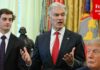
A Midwest archbishop says a sacred Oval Office prayer was turned into political content without consent, and he is apologizing for it.
Story Snapshot
- Milwaukee Archbishop Jeffrey Grob apologized for praying with President Trump after a White House video spread online.
- Grob says the administration publicized photos and video without the bishops’ permission.
- The bishops expected a private policy meeting and possible private prayer, not a political photo moment.
- Grob says the imagery “manipulated” a sacred act and was not an endorsement of Trump or his party.
Archbishop’s Apology and Consent Claim
Milwaukee Archbishop Jeffrey Grob issued a public apology after a video showed him and other bishops praying behind President Trump in the Oval Office. Grob wrote that the administration posted video and photos without consent from the bishops, and that no permission was given to distribute the media publicly. He said the moment, which he viewed as sacred, was “manipulated” once it went online. He stressed the meeting and prayer were not endorsements of Trump, his policies, or his party.
Grob’s apology followed a wave of attention after the White House visit on October 22. Reports say the bishops met with the president for about 90 minutes before staff led them into the Oval Office, where they stood behind Trump to pray. Soon after, the administration shared the images on its channels, which traveled quickly across social media. Grob said the group did not know a video would be taken and did not grant approval to post it online.
What Bishops Say They Were Told
Grob’s account says the bishops accepted an invitation framed as a private discussion on policy, with a chance for a private prayer. He contrasted that plan with how the prayer looked once it was released: a staged political scene. Several outlets summarized the mismatch he described between a closed-door policy talk and the publicized visuals that implied support for the president. The archbishop apologized for the pain caused to Catholics who saw the video as a partisan message rather than a pastoral moment.
The apology highlights how fast official images can shape a story before participants speak. The White House, with control over venue and distribution, set the first frame by posting the imagery. Grob’s written statement arrived days later and tried to add context and limits, including a clear denial that the bishops endorsed any politician. That lag matters because short clips often set public opinion early, especially when symbols like the Oval Office and clerical vesture are in view.
Why Visual Framing Matters Beyond This Event
This clash shows how a brief clip can carry meanings the people in it do not intend. Communication research finds that images use setting, posture, and proximity to signal alignment, even without words. Handlers often choose these visuals to build identity and send cues that news headlines cannot carry on their own. In this case, the Oval Office setting and a prayer circle suggested approval, even as Grob later said the act was spiritual, private in spirit, and not political.
Twelve U.S. Catholic bishops say the White House exploited a private Oct. 22 meeting after it posted video of them praying over Trump in the Oval Office, a video they say was recorded without their knowledge less than two weeks before the Nov. 3 midterms.
Milwaukee Archbishop… pic.twitter.com/gBsk5zuJP3
— Clash Report (@clashreport) October 25, 2026
The moment also speaks to wider public worries about power and trust. Many Americans on the left and right feel leaders use staged images to claim moral cover while avoiding hard work on real issues. A sacred act becoming viral content feeds that concern. Grob’s statement meets people in that space: he accepts responsibility for his part, rejects any endorsement, and asks forgiveness for how the images landed. His account urges stricter consent and clearer rules for official recordings.
What We Know, and What Comes Next
Published reports center on Grob’s description and apology, plus basic timing of the meeting and release. The accounts do not name the staffer who approved the post or explain the full media plan, but they consistently quote Grob’s consent claim and his rejection of political use. For readers, the practical takeaway is simple: official images can define events within hours, so faith and civic leaders should set recording terms in writing before any high-profile meeting.
Sources:
lifesitenews.com, nytimes.com, jsonline.com
© dailyvantage.com 2026. All rights reserved.