(DailyVantage.com) – The U.S. Air Force’s F-47 Next Generation Air Dominance fighter represents a critical gamble—failure could cost American lives in a future conflict with China, as aging F-22 Raptors lose their edge against Beijing’s expanding stealth fleet.
Story Snapshot
- Boeing’s $20 billion F-47 contract, signed by President Trump in 2025, aims to deliver 185 sixth-generation fighters by the early 2030s to replace the aging F-22 fleet.
- Each F-47 will control up to eight AI-driven drones, transforming 185 jets into a networked force of 1,500 combat platforms designed to dominate China’s J-20 and J-35A fighters.
- The fighter boasts Mach 2+ speed, a 1,000+ nautical mile combat radius—double the F-22’s range—and advanced stealth tailored for Indo-Pacific operations.
- Production is on track for a 2028 first flight, but delays or failure risk leaving U.S. forces vulnerable as China rapidly modernizes its air capabilities.
Boeing’s Existential Victory Reshapes Air Dominance
President Trump signed a $20 billion contract with Boeing in spring 2025 to develop the F-47, the Air Force’s first sixth-generation fighter. The deal rescued Boeing from financial struggles in its commercial aviation division, making the NGAD program existential for the company’s defense operations. Boeing beat Lockheed Martin, the maker of the F-22 and F-35, in a competition to design a fighter capable of countering China’s growing stealth fleet in the Pacific. Production began in early 2026, with the program reportedly “doing exceptionally well” and targeting a 2028 first flight for prototypes.
Drone Swarms Multiply Combat Power Beyond Traditional Jets
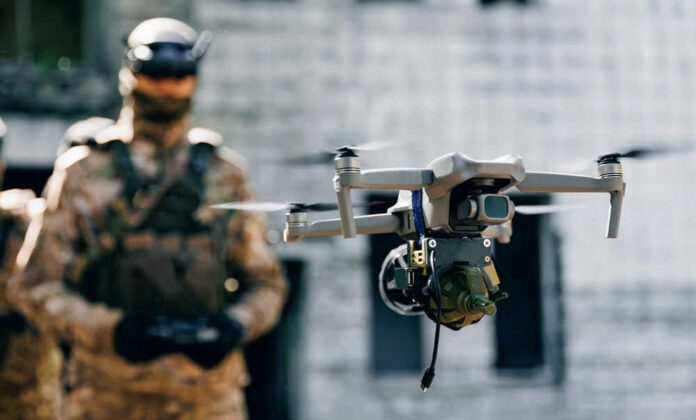
The F-47’s defining feature is its ability to command up to eight Collaborative Combat Aircraft per jet, AI-driven drones that swarm enemy targets, gather intelligence, and absorb defensive fire. With 185 F-47s planned, the fleet effectively becomes 1,500 combat platforms—a paradigm shift from traditional fighter math. These drones integrate with the F-47’s sensor fusion system, enabling real-time targeting for hypersonic missiles and directed-energy weapons. This manned-unmanned teaming approach prioritizes pilot safety while overwhelming adversaries like China’s J-20, which lacks comparable drone integration and operational range for Pacific distances.
‘Failing Could Cost Lives’: Why the F-47 NGAD Is the Air Force’s ‘Most Important’ Fighter Everhttps://t.co/nfepJ6XorT
— 19FortyFive (@19_forty_five) May 6, 2026
Range and Stealth Address Pacific Theater Challenges
The F-47’s 1,000+ nautical mile combat radius doubles the F-22’s reach, critical for operating across the vast Indo-Pacific without constant refueling in contested airspace. Air Force leaders emphasized this capability as essential for countering China’s anti-access strategies, which rely on pushing U.S. forces beyond striking distance of Taiwan or the South China Sea. Advanced stealth coatings and a modular design allow the F-47 to adapt to evolving threats, addressing shortfalls in the F-22’s aging airframe. The jet’s Mach 2+ speed and payload capacity exceed current Chinese fighters, according to defense analysts, though exact specifications remain classified.
High Stakes in a New Era of Peer Conflict
The F-47 program emerges as U.S.-China tensions escalate over Taiwan and maritime disputes, with Beijing deploying hundreds of J-20s since 2017 and introducing the carrier-based J-35A. The Air Force’s 187 operational F-22s, built in the 2000s, face sustainability challenges and limited range for Pacific operations. Failure to field the F-47 risks ceding air superiority in a conflict analysts warn could erupt within years. The program’s $300 million per-unit cost sparked debates in 2024 that nearly led to cancellation, but Boeing’s pivot and Trump’s backing revived momentum. The stakes extend beyond hardware—pilots and ground forces depend on air dominance to survive modern combat.
Skeptics Question Costs and Classified Details
Despite optimism from Pentagon officials, the F-47 faces scrutiny over its estimated $55 billion total cost and secrecy surrounding performance data. Critics note the 185-jet fleet size remains unconfirmed beyond initial reports, with some questioning whether budget overruns could shrink production. The Ukraine war exposed vulnerabilities in fifth-generation assumptions, prompting debates over whether sixth-generation designs adequately address drone swarms and electronic warfare. Lockheed Martin, sidelined in the competition, continues lobbying for upgraded F-35 variants as a lower-cost alternative. Yet proponents argue the F-47’s integration of AI, hypersonics, and extended range represents a necessary leap to counter adversaries investing heavily in their own next-generation platforms.
Sources:
185 F-47 NGAD Fighters, Up to 8 Drones Each: That’s Not a Fleet, That’s 1,500 Combat Platforms
New U.S. Air Force F-47 NGAD Stealth Fighter Is a Paradigm Shift China Won’t Know How to Match
Bolt from the Blue: What We Know and Don’t Know About the US’s Powerful F-47 Fighter
Why Boeing’s F-47 NGAD Next-Gen Fighter Win Was Existential for the Company
Don’t You Dare Think the F-47 NGAD Is Just Another Stealth Fighter
F-47 Program on Track for 2028 Flight
Copyright 2026, DailyVantage.com