(DailyVantage.com) – Trump’s warning that a “massive armada” is moving into the Middle East puts Iran on notice that Washington is done issuing empty red lines.
Story Snapshot
- President Trump warned Iran that U.S. military strikes could follow if Tehran refuses to abandon its nuclear path.
- The USS Abraham Lincoln carrier strike group entered U.S. Central Command’s area as tensions rose and diplomacy stalled.
- Iran’s foreign minister said Iran’s forces have “fingers on the trigger” and promised immediate retaliation for any aggression.
- Secretary of State Marco Rubio framed the buildup as baseline defense for 30,000–40,000 U.S. troops within range of Iranian drones and missiles.
Trump’s Ultimatum Meets a Carrier Strike Group
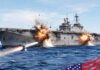
President Donald Trump delivered his latest warning to Tehran on January 29, 2026, tying diplomacy to a clear military signal: a major U.S. naval presence moving into the region. The USS Abraham Lincoln aircraft carrier, accompanied by destroyers equipped with Tomahawk missiles, arrived in the Middle East days earlier, adding roughly 5,000 personnel and a large strike-aircraft package to America’s posture. The deployment is the first U.S. carrier presence there since summer 2025.
Trump’s demands were specific: a permanent end to uranium enrichment, limits on Iran’s ballistic missile stockpile, and an end to support for the Axis of Resistance. He also pointed back to the June 2025 strikes on Iranian nuclear sites—an operation he said “obliterated” parts of the program—warning that a future attack would be worse if Iran refuses to “come to the table.” Public messaging and force movement are now reinforcing each other.
Iran Signals Readiness, While Pointing to Past U.S. War Costs
Iran’s response, delivered the same day, emphasized deterrence through retaliation. Foreign Minister Seyed Abbas Araghchi said Iran’s armed forces were prepared to respond “immediately and powerfully” to any aggression, claiming the regime learned “valuable lessons” from the June 2025 conflict involving Iran, Israel, and the United States. Iran’s U.N. mission also pushed back by invoking the heavy costs of U.S. wars in Afghanistan and Iraq, arguing that Washington previously squandered trillions and thousands of lives.
The most important factual takeaway is that both sides are now describing the situation in military terms even while leaving the door cracked for intermediaries. Araghchi denied requesting new talks but said Iran is in touch with various middlemen. With no reported breakthrough in direct negotiations, the risk is that public threats replace private bargaining. When that happens, leaders can feel locked into their own rhetoric, and small miscalculations can quickly become larger crises.
Rubio’s Argument: Deterrence Is About Protecting Americans First
Secretary of State Marco Rubio, speaking as the buildup became public, framed the posture as defensive and troop-focused. Rubio said 30,000 to 40,000 U.S. personnel across eight or nine facilities in the region sit within reach of “thousands” of Iranian one-way drones and short-range ballistic missiles. From a conservative, limited-government perspective, the cleanest rationale for any overseas deployment is protecting Americans already in harm’s way, not nation-building or open-ended social engineering missions.
That framing matters because it addresses a major post-Iraq concern among Trump voters: Washington’s habit of drifting from defined objectives into endless “projects.” The sources describe the current posture as a baseline requirement to defend forces and deter attacks, not as a pre-announced invasion plan. At the same time, the combination of an aircraft carrier, destroyers, and additional aircraft increases the consequences of a single incident, whether that’s a drone strike, a naval encounter, or a proxy escalation.
Iran’s Internal Instability and the Escalation Risk
Iran’s domestic situation is a critical part of the context. Reports describe nationwide anti-government protests that began with currency collapse and escalated into a broader anti-regime movement, followed by a government crackdown with a death toll reported in the thousands, though exact figures remain unconfirmed. Analysts cited in the research describe the regime as operating in “survival mode,” a condition that can make decision-making more erratic and retaliation more attractive than compromise.
One expert warning highlighted that Iran has naval and short-range missile capabilities designed to threaten U.S. warships, and that some of those tools were not used during the June 2025 conflict—meaning they may remain intact. That does not prove Iran will attack, but it underlines why deterrence is not cost-free: every added U.S. asset can deter aggression while also offering Iran more targets if Tehran chooses escalation. The lack of clear diplomatic progress keeps this standoff dangerously tight.
Regional politics further complicate the picture. Saudi Arabia, a key U.S. partner, reportedly ruled out allowing its airspace or territory to be used for military operations against Iran, while also seeking a diplomatic off-ramp. That signals two realities at once: Gulf leaders fear the blowback of a broader conflict, and Washington’s freedom of action may depend on options beyond traditional basing and overflight arrangements. For Americans watching inflation and budgets at home, any conflict that spikes energy prices or triggers a prolonged deployment has real pocketbook consequences.
Sources:
https://www.politico.com/news/2026/01/28/trump-iran-threats-massive-armada-00751756
Copyright 2026, DailyVantage.com