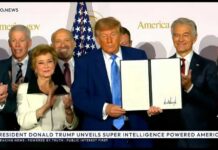
Top artificial intelligence chiefs left the White House with a voluntary “accord” to police themselves — not a new law — after meeting President Trump.
Story Highlights
- President Trump hosted a White House lunch with leading artificial intelligence executives.
- House Speaker Mike Johnson said the group signed an accord on artificial intelligence standards.
- Trump and attendees emphasized industry self-regulation over new federal rules.
- The event fits a broader trend of voluntary commitments rather than binding regulation.
White House Meeting Brings Together Top Technology Chiefs
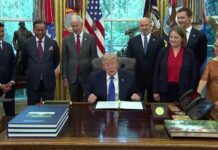
On September 29, President Trump gathered leading artificial intelligence executives at the White House for a policy lunch focused on innovation and guardrails. Reuters reported the meeting would seek balance between growth and oversight, with House Speaker Mike Johnson participating alongside the executives. A separate Reuters report listed expected attendees, including Anthropic Chief Executive Dario Amodei, Meta Chief Executive Mark Zuckerberg, and Google parent Alphabet Chief Executive Sundar Pichai. The session aimed to shape near-term norms as artificial intelligence use spreads across the economy.
After the lunch, Speaker Johnson said the executives signed an “accord” on artificial intelligence standards, though he did not share full details on its scope or enforcement. President Trump promoted industry “self-regulation” as the preferred approach and highlighted the economic upside of more data centers and new artificial intelligence tools. News outlets present described a large gathering, with a seating chart showing Trump near several major technology leaders, underscoring the event’s high profile and the administration’s light-touch posture.
Voluntary Accord Signals Preference for Self-Policing
Coverage from multiple outlets described a voluntary pledge, not a binding rule. House Speaker Johnson’s statement made clear that the signers agreed to an accord on standards but did not offer legal mechanisms or penalties. President Trump echoed that theme, calling for strong self-policing by the companies and minimal new regulation, according to post-lunch accounts. This places responsibility on the same firms building artificial intelligence to set testing practices, share risk information, and address safety issues before harms reach the public.
This model mirrors recent United States practice of using voluntary commitments for fast-moving technology. In 2023, the prior administration rolled out nonbinding artificial intelligence safety pledges with major firms, which the White House itself framed as a first step rather than enforceable policy. Today’s accord appears to follow that path: convene the key players, secure public promises, and rely on market pressure and reputation to drive follow-through. That approach can move quickly, but it leaves open questions about consistency and accountability across the industry.
What Both Sides Want — And What Everyday Americans Care About
Participants and the administration share a desire to keep the United States ahead in artificial intelligence while reducing risks that could threaten jobs, privacy, or safety. Trump’s message stressed growth, lower barriers, and private oversight, which appeals to leaders who fear heavy rules will slow progress or push development offshore. Technology companies gain a seat at the table and influence over standards if self-regulation remains the default, while avoiding the costs and delays that come with complex federal rulemaking.
Donald Trump had a private White House dinner with Anthropic CEO Dario Amodei. This marked their first one-on-one meeting following months of debate regarding AI speed and its associated risks. Prior to the dinner, Trump reached out to Amodei, expressing mutual respect and a… https://t.co/7brm22mSX4 pic.twitter.com/BYNjNxG1oX
— Joe Pelayo (@JoeHeadhunter) September 29, 2026
Many Americans, across party lines, worry that powerful leaders meet behind closed doors yet leave the public with vague promises. The voluntary accord advances cooperation but does not carry the weight of law or clear enforcement. That can feel like government outsourcing its duty to guard workers, parents, and small businesses. Supporters see speed and flexibility. Critics see the largest companies writing their own rules. Both views track with the facts: the pledge is real, and it is voluntary.
What To Watch Next: From Pledge To Practice
The key test now is how companies implement the accord in daily practice. Watch for concrete steps: external safety tests before release, clearer labels on artificial content, and stronger data protections. Look for common benchmarks that smaller firms can use so the field does not tilt to the biggest players. Congress may also consider targeted laws if self-policing falls short or if harms mount, but for now the White House strategy relies on industry follow-through rather than new mandates.
Sources:
youtube.com, nbcnews.com, reuters.com, thehill.com, cnbc.com
© dailyvantage.com 2026. All rights reserved.