(DailyVantage.com) – Congressional brinkmanship threatens to paralyze the federal government, unless an unlikely truce emerges in the next four weeks, a scenario that could upend everyday life for millions and redefine political narratives heading into 2026.
Story Highlights
- Democratic leaders Schumer and Jeffries demand bipartisan talks to avert a government shutdown as the September 30 funding deadline looms.
- Intense partisan gridlock, a compressed legislative calendar, and high-stakes cuts to Medicaid and rural hospitals complicate negotiations.
- President Trump’s skepticism and the Senate’s filibuster rules create additional barriers to a swift compromise.
- Potential shutdown would disrupt federal services, delay paychecks, and erode public trust in government competence.
Democratic Leadership Sounds the Alarm as Deadline Approaches
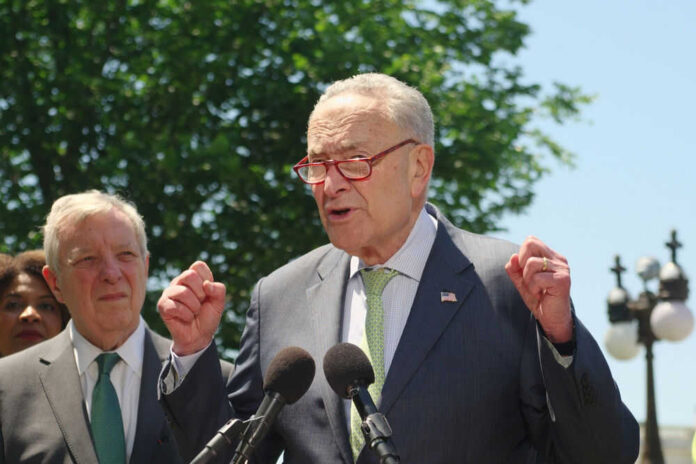
Senate Minority Leader Chuck Schumer and House Minority Leader Hakeem Jeffries are not mincing words. As Congress reconvenes after its August recess, both leaders are issuing blunt warnings: the only way to avoid a government shutdown by September 30 is to embrace genuine bipartisanship. In a climate thick with partisanship, their calls to negotiate across the aisle are as much a challenge as a plea, aimed at Republican counterparts and the American public. Schumer’s September 2 letter makes it clear, without a deal that satisfies both parties, the lights could go out in Washington.
With legislative days dwindling due to a scheduled Rosh Hashanah recess, the urgency is palpable. Schumer and Jeffries are framing this as a test of shared responsibility, seeking to cast any failure not as inevitable dysfunction, but as a conscious choice by those who refuse to bargain. The short window for action magnifies every move, every statement, and every sign of intransigence. As the countdown accelerates, even seasoned Capitol Hill watchers admit this standoff feels different, tighter, riskier, with less margin for error than in years past.
Partisan Divides, Policy Flashpoints, and the Ghost of Shutdowns Past
Federal funding battles are hardly new. The U.S. government runs on annual appropriations bills, and when those stall, shutdowns follow, halting “non-essential” operations and sending hundreds of thousands of workers home without pay. The 2018-2019 shutdown, triggered by border wall disputes, lasted a record 35 days. This year, the policy landmines are Medicaid, rural hospitals, and foreign aid, with Democrats vowing to restore cuts and Republicans eyeing fiscal restraint. President Trump, wielding influence over GOP lawmakers, has called bipartisan talks a “waste of time,” signaling little appetite for compromise. The Senate’s filibuster rules, requiring 60 votes to advance funding bills, make bipartisan buy-in non-negotiable. No side can go it alone, yet rhetoric on both sides suggests patience is in short supply and brinkmanship is in high demand.
Pressure extends beyond the Capitol. Federal contractors, hospital administrators, and social service providers are bracing for impact. Congressional leaders, aware of the real-world consequences, are walking a political tightrope, trying to secure enough concessions to avoid backlash from their base, without pushing the government over the edge into a shutdown vortex. The memory of past shutdowns looms large, with economic disruptions, plummeting morale, and political blame games still fresh in the public mind.
The Stakes for Americans: Services, Paychecks, and Trust on the Line
Failure to reach a deal by September 30 would trigger immediate and sweeping consequences. Non-essential federal workers would be furloughed, paychecks delayed, and countless services, from passport processing to rural health programs, would grind to a halt. For millions of Americans, the shutdown would be more than a Washington drama; it would be a disruption to daily life, pay, and even medical care. Political strategists warn that repeated threats of shutdowns corrode public trust in government, fueling cynicism and disengagement.
The economic fallout could extend beyond government employees. Federal contracts would be frozen, payments to suppliers delayed, and consumer confidence shaken. Healthcare providers, especially in rural areas, face existential threats if funding is cut or delayed. Each day without resolution compounds the damage. Meanwhile, both parties prepare to weaponize the crisis for voter mobilization and blame assignment, knowing that public opinion in the aftermath could reshape the 2026 midterm landscape.
Expert Analysis: Bipartisanship as Imperative, Not Option
Policy analysts and economists are nearly unanimous: bipartisan cooperation is not optional. The Senate’s rules and the closely divided Congress leave no room for one-party solutions. Experts point to the ripple effects of even brief shutdowns, delayed pay for workers, lost productivity, and undermined faith in government institutions. Academic observers note an alarming trend: shutdown threats are becoming routine bargaining chips, reflecting and reinforcing deepening polarization. Conservative commentators sometimes argue that shutdowns are leverage for fiscal discipline, but economists counter that the cost, to government effectiveness and the economy, rarely justifies the tactic.
Major news outlets and policy organizations agree on the stakes. The window for action is closing fast, and while past crises have produced last-minute deals, the prevailing mood in Washington is one of suspicion, not trust. The next few weeks will test whether political leaders can put country above party, or whether Americans will once again pay the price for legislative gridlock.
Copyright 2025, DailyVantage.com.