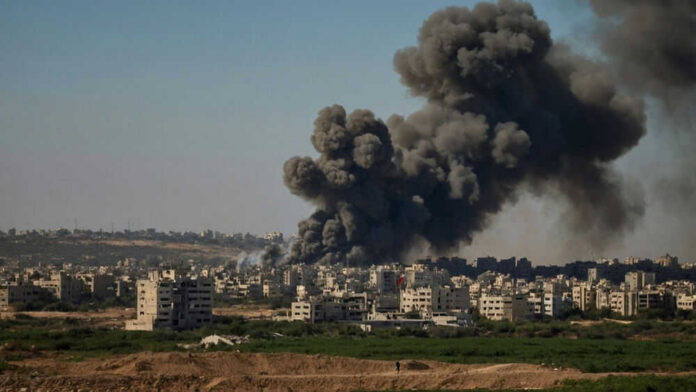
(DailyVantage.com) – U.S.-Israeli strikes didn’t just hit Iran’s missiles—they went after the regime’s internal security machinery in a Kurdish city where Tehran’s grip has always been shaky.
Story Snapshot
- Explosions in Sanandaj, Iran’s Kurdistan Province, aligned with reported U.S.-Israeli strikes on internal security and military infrastructure.
- Open-source reporting described targets including police stations, an IRIB facility, and an IRGC divisional base—assets tied to regime control and enforcement.
- Analysts assessed the Sanandaj focus as part of a broader campaign to degrade Iran’s ability to repress unrest and coordinate retaliation.
- Iranian officials publicly projected control while warning “separatists,” underscoring fears of ethnic unrest amid wartime disruption.
Why Sanandaj Matters in This Phase of the War
Sanandaj is not just another dot on the map in the 2026 Iran War. It is the capital of Iran’s Kurdistan Province, a region with a long history of tension between Kurdish communities and Tehran’s central власти. Reporting indicated strikes in and around Sanandaj on March 2–3 that hit sites associated with security enforcement and military presence. That targeting choice matters because internal security nodes are the tools regimes use to control populations.
Think-tank reporting framed the Sanandaj strikes as part of a broader effort to reduce Iran’s capacity to coordinate repression and retaliation, including against potential unrest in restive areas. Open-source updates also pointed to satellite-confirmed damage at an IRIB facility in Sanandaj, reinforcing claims that the campaign expanded beyond classic battlefield targets. The available sources do not provide a complete casualty breakdown specific to Sanandaj, and civilian impacts remain difficult to verify city-by-city.
What Was Reportedly Targeted: Police, IRIB, and the IRGC
Available reporting described a set of targets that reads like a blueprint of state control. On March 3, a U.S.-Israeli coalition reportedly struck multiple police stations in Sanandaj and an IRIB station, with one location identified as Station No. 15 through satellite imagery. Separate reporting said strikes also hit the IRGC’s 22nd Divisional Base in Sanandaj, a military asset tied to Iran’s internal and regional security posture.
This pattern fits a campaign aimed at disrupting command-and-control, intimidation capacity, and propaganda distribution rather than simply cratering runways or ammunition depots. The research also notes a prior strike on a Kurdistan Province Law Enforcement Command headquarters in Sanandaj on March 2, suggesting a sustained focus rather than an isolated hit. The sources do not prove intent beyond target selection, but they consistently describe security and enforcement infrastructure as the aim.
Iran’s Messaging: “Fully in Control” While Threatening “Separatists”
Iranian leadership messaging during the strikes emphasized control and deterrence. Reports cited Ali Larijani asserting the armed forces were “fully in control” and promising no leniency for “separatists.” That language is revealing because it ties the wartime situation to domestic political fear—especially in Kurdistan Province, where the regime has historically treated dissent as a security threat rather than a political dispute. The research stops short of confirming any active separatist uprising tied to the strikes.
Still, when a government publicly warns internal groups during an external war, it signals concern about regime stability at home. Sanandaj’s Kurdish-majority context is central here: a degraded police and IRGC footprint could reduce Tehran’s capacity to clamp down quickly, even if only temporarily. The sources describe uncertainty around the role of separatist activity, and no evidence in the provided research conclusively links the strikes to direct coordination with Kurdish factions.
Broader War Context: Retaliation, Energy Disruption, and the Limits of Open Data
The Sanandaj explosions occurred amid a wider escalation that included strikes on missile sites and other strategic infrastructure and Iranian retaliatory launches targeting Israel and Gulf states. Open-source summaries cited Iranian casualty totals rising into the hundreds by early March, while other reporting described regional spillover—energy disruptions and incidents affecting Gulf countries. The research also referenced international monitoring indicating no radiological release from damage reported at Natanz, highlighting that not every dramatic headline equates to worst-case outcomes.
Several explosions hit the Iranian city of Sanandaj https://t.co/nczqWc1Doq via @YouTube@MattMorseTV
— Jrspc (@jrspc17) March 6, 2026
For Americans watching this in 2026—after years of foreign-policy drift, domestic chaos, and globalist talking points—the key point is clarity: the Sanandaj strikes, as described, centered on the regime’s coercive apparatus, not symbolic targets. That distinction matters because internal security organs are how authoritarian governments survive pressure. The limits are real, though: much of the available detail relies on compiled timelines and think-tank assessments, and independent on-the-ground confirmation remains constrained.
Sources:
Timeline of the 2026 Iran conflict
Iran Update, Morning Special Report, March 5, 2026
Iran Update, Morning Special Report, March 3, 2026
US-Israeli strikes hit Iran’s missile, nuclear, political, and repression sites
Copyright 2026, DailyVantage.com