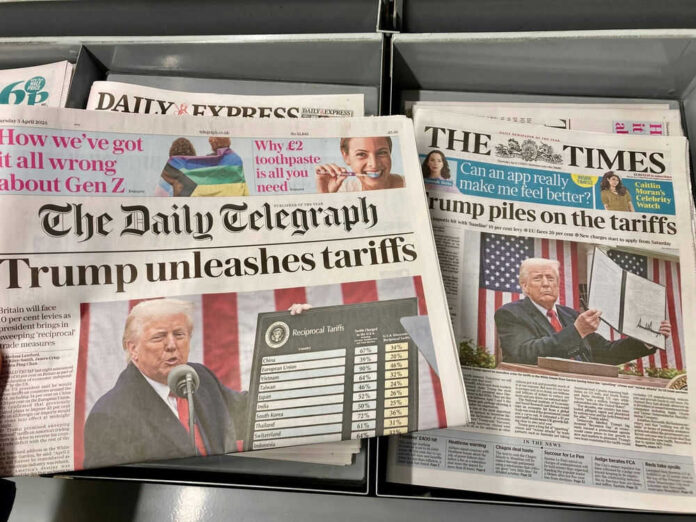
(DailyVantage.com) – Democrats are pushing a new talking point that Trump’s 2025 tariffs are a “$1,200 tax” on the average household, but the real battle is over whether America should keep surrendering its supply chains to globalism or finally rebuild domestic industry on our own terms.
Story Highlights
- Democrats claim Trump’s 2025 tariffs cost the average U.S. household about $1,200 in higher prices.
- Their estimate comes from turning roughly $159 billion in new tariff revenue into a per-household “bill.”
- Left-leaning economists call the tariffs “regressive” and “fiscal folly,” warning of slower growth.
- Trump’s team frames tariffs as a lawful tool to fight unfair trade, rebuild industry, and end dependence on China.
Democrats Turn Tariffs Into a Campaign Weapon
Democratic members of Congress on the Joint Economic Committee have rolled out a headline-ready claim: since Trump returned to the White House and ramped up tariffs in early 2025, the average U.S. household has paid roughly $1,200 more through higher prices. They base this on Treasury data showing about $159 billion in additional tariff revenue from February through November 2025, then divide that pot across American households to brand it a “massive hidden consumer tax.”
That “hidden tax” language is not accidental; it is designed to paint Trump’s trade agenda as a betrayal of working- and middle-class families and to revive the same inflation anger voters felt under Biden. Democrats highlight that tariffs raise the sticker price of imported goods and can ripple through the supply chain into everything from clothing to appliances. Their strategy is simple: when families feel squeezed, blame the White House and label tariffs the biggest consumer tax in a generation.
What the Economic Models Say About Costs and Trade-Offs
Behind the talking points sits a battery of studies from places like Yale’s Budget Lab, the Congressional Budget Office, and think tanks that generally lean technocratic and skeptical of protectionism. Yale’s modeling suggests that when you include all tariffs in force during 2025, Trump’s new rounds plus older ones and expected foreign retaliation, overall consumer prices run a few percentage points higher, implying several thousand dollars in lost purchasing power for the average household in the short run. CBO similarly concludes that higher tariffs shave real income and modestly slow growth versus a no-tariff-hike baseline.
These estimates feed Democratic claims that tariffs hit poorer households harder, because lower-income families spend more of their budget on goods subject to duties. Some researchers project hundreds of thousands more people falling below official poverty lines once higher prices filter through. For conservatives, those findings matter, but so do the assumptions buried inside: most models treat global supply chains as basically efficient and assume foreign producers will not meaningfully absorb the cost, while giving little weight to the value of strategic independence, stronger bargaining power, or the long-term payoff from reviving domestic manufacturing capacity.
Trump’s Case: National Security, Jobs, and Ending Dependency
Trump campaigned in 2024 on exactly this tougher tariff posture, promising a universal baseline tariff and punitive rates on China, Canada, and Mexico to force fairer trade and reshore production. Once back in office in January 2025, he followed through, approving broad-based hikes on imports from key partners and higher duties on sectors like autos, steel, aluminum, and other manufactured goods. For his supporters, these are not abstract numbers on a spreadsheet but tools to stop the hollowing out of American factories and the dangerous dependence on Beijing for critical goods.
The administration defends the tariffs as lawful instruments Congress itself gave presidents under trade statutes, and as a way to make foreign governments, not U.S. taxpayers, bear more of the cost of access to the American market. Supporters argue that modest price bumps today are an investment in tomorrow’s stronger job base, domestic supply chains, and national security. They also note that many of the original Trump tariffs survived four years of Biden, undercutting claims that only Republicans suddenly discovered this revenue source or that Democrats were consistently opposed to tariff protection when it suited their union or industrial allies.
Who Really Pays, and What Voters Should Watch Next
For families trying to stretch a paycheck, the key question is not just whether tariffs raise some prices, but whether the overall package of policies leaves them better off than the pre-2025 status quo of offshoring, cheap imports, and stagnant factory towns. The same economists warning loudly about a $1,200 “tariff tax” were often quieter when Biden-era spending, regulation, and energy restrictions helped ignite the inflation spiral your grocery bill just lived through. Their models rarely credit the benefit of supply-chain resilience when crises hit, or the constitutional concern with ceding economic leverage to hostile regimes.
Tariffs have cost U.S. households $1,200 each since Trump returned to the White House, Democrats say https://t.co/QAnA12UNWR @AP
— Patrick Whittle (@pxwhittle) December 11, 2025
Going forward, conservatives should watch two fronts. First, whether Congress tries to claw back tariff authority from the presidency, which would shift power over trade away from an elected executive and toward the same professional political class that presided over decades of deindustrialization. Second, whether future tariff revenue gets used to reduce other taxes on work and family or simply folded into the permanent spending machine. Tariffs can be either a targeted tool for sovereignty or just another excuse for big-government expansion; the difference will be decided in policy fights now underway.
Copyright 2025, DailyVantage.com