(DailyVantage.com) – President Trump declares 34 ships crossed the Strait of Hormuz on Sunday—the most since America’s naval blockade began—forcing Iran’s hand in a high-stakes showdown over global oil flows.
Story Highlights
- Trump hails 34-ship transit as proof U.S. pressure is reopening vital maritime routes amid US-Israel-Iran war.
- U.S. Navy destroyers transited Saturday ahead of mine-clearing, signaling resolve to secure the Strait handling 20% of world oil.
- Selective blockade targets Iranian ports only, starting Monday, sparing non-Iranian traffic to limit global disruption.
- Supertankers queue with 21 million barrels as traffic halts post-announcement, spiking oil prices and pressuring Tehran.
Trump Spotlights U.S. Naval Success
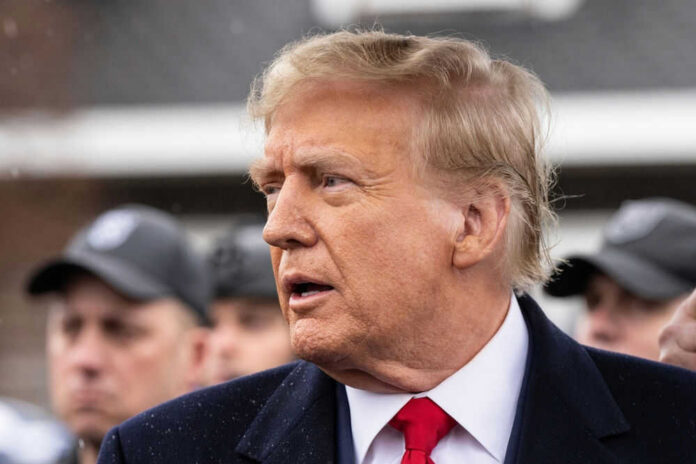
President Donald Trump announced that 34 ships transited the Strait of Hormuz on Sunday, April 12, 2026, marking the highest number since the U.S.-enforced naval blockade began. He framed this surge as evidence that American pressure is succeeding in restoring maritime traffic disrupted by the US-Israel-Iran war. The Strait, a narrow chokepoint between Iran and Oman, carries about 20% of global oil, making control critical for energy security and economic stability. Trump’s statement underscores U.S. strategy to compel Iran toward diplomacy through targeted economic leverage.
U.S. Navy Prepares Blockade Enforcement
Two U.S. Navy destroyers, USS Frank E. Peterson Jr. and USS Michael Murphy, transited the Strait on Saturday, April 11, ahead of mine-clearing operations led by U.S. Central Command. Admiral Brad Cooper, CENTCOM commander, pledged to establish safe passage for commerce. The blockade activated Monday at 1400 GMT, focusing solely on Iranian ports and coastal areas while allowing non-Iranian vessels to pass. This selective approach minimizes international backlash while isolating Iran’s oil exports. Post-ceasefire, over 40 commercial ships had crossed in recent days before traffic halted again.
Trump says 34 ships crossed Hormuz Sunday, most since war began pic.twitter.com/qsrrKTKQb5
— LWS Financial Research (@lwsresearch) April 13, 2026
Supertankers including 10 VLCCs and one Suezmax, holding roughly 21 million barrels, now queue in the Gulf of Oman. Two vessels turned back after the blockade announcement. U.S.-Iran peace talks in Pakistan failed, prompting Trump’s order. Iranian leadership remains defiant, but the blockade squeezes their economy. Israel struck 150 Hezbollah targets during the war, heightening regional tensions. CENTCOM uses destroyers and incoming drones for mine clearance to aid non-Iranian flows.
Blockade Targets Iran’s Defiance
The U.S. holds naval superiority in the region, uncoordinated with Iran, enforcing the blockade impartially against Iran-bound traffic. Lloyd’s List Intelligence reports all traffic stopped post-announcement. Trump called Sunday’s “foolish closure” a thing of the past, positioning the 34-ship peak as a win for America First policies. This move pressures Tehran without broad disruptions, aligning with conservative priorities of strong defense and energy independence over globalist entanglements.
Short-term oil price surges hit global markets from the halt, while long-term outcomes could force an Iran deal or escalate conflict. Maritime firms seek safe resumption, but Iranian flows remain limited. Trackers note post-ceasefire uptick before the fresh stoppage, with Trump’s 34-ship figure specific to him, lacking independent daily counts. U.S. actions rely on official statements, corroborated across outlets, highlighting power dynamics where American resolve challenges elite-driven foreign policy failures.
BREAKING – Trump says 34 ships crossed Hormuz Sunday, most since war began https://t.co/JpQLE9Jl7B pic.twitter.com/yzP64sqtl6
— Insider Paper (@TheInsiderPaper) April 13, 2026
Economic Pressure Mounts on Tehran
Global energy markets face risks as the blockade disrupts 20% of oil transit, backing up tankers and driving price volatility. U.S. strategy aims to reshape chokepoints by curbing Iranian aggression, protecting American interests and allies like Israel. Both conservatives frustrated by past globalism and liberals wary of elite corruption see this as government flexing muscle against threats, yet questioning if it truly serves working Americans over powerful insiders. Mine-clearing progresses to enable commerce flow.
Sources:
https://fortune.com/2026/04/11/us-navy-ships-strait-of-hormuz-crossing-ceasefire-talks-pakistan/
Copyright 2026, DailyVantage.com