(DailyVantage.com) – Iran’s theocratic regime faces its gravest threat since the 1979 Islamic Revolution as economic collapse, mass protests, and Trump administration military strikes converge to create a historically rare window for regime change that could reshape the Middle East.
Story Overview
- Supreme Leader Khamenei’s death creates succession crisis while protesters reject both reformist and hardline factions
- Trump administration launched military strikes in February 2026 and explicitly called for Iranians to overthrow their government
- Regime massacred protesters in December 2025-January 2026 as economic collapse leaves government unable to address citizen grievances
- Iran’s regional allies Hezbollah, Hamas, and Assad regime have been devastated or deposed, leaving Tehran isolated
- Islamic Revolutionary Guards Corps remains entrenched despite regime vulnerability, complicating transition prospects
Regime Faces Perfect Storm of Crises
Iran’s theocratic government confronts unprecedented pressure from multiple directions simultaneously. The death of Supreme Leader Khamenei created a succession vacuum that threatens elite coordination within the regime’s power structure. Economic sanctions reinstated by the United Nations in September 2025, combined with military expenditures defending regional proxies, have depleted government resources. Citizens face increasingly dire living conditions while the regime possesses no economic leverage to address their legitimate grievances. This convergence of internal weakness and external pressure represents the most dramatic upheaval since the Islamic Revolution established theocratic rule forty-seven years ago.
Trump Administration Takes Direct Action
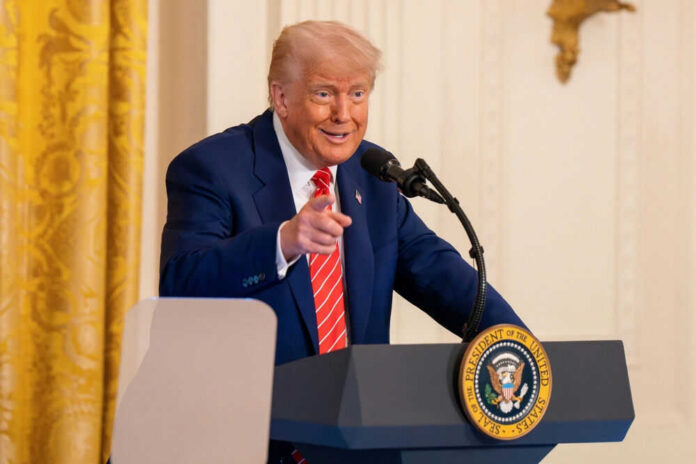
President Trump’s approach marks a fundamental shift from previous administrations’ diplomatic strategies. The administration launched military strikes against Iran on February 28, 2026, following earlier joint Israeli-U.S. operations in June 2025 that targeted three nuclear facilities. Trump explicitly told Politico on January 17, 2026, that “it’s time to look for new leadership in Iran.” The administration called on Iranian citizens to “rise up and overthrow the government” in a recorded video statement, representing the clearest regime change advocacy from a sitting president. Trump hosted Israeli Prime Minister Netanyahu in December 2025 and threatened strikes on Iran’s missile program if not rolled back, maintaining a “locked and loaded” military posture.
Protesters Reject All Political Factions
Mass demonstrations erupted in December 2025 as economic conditions deteriorated beyond tolerable levels. Iranian protesters chant “Reformer, Hardliner, the game is over,” signaling their rejection of both establishment political camps. The reformist movement, which previously served as a safety valve for public discontent, has lost all credibility after President Hassan Rouhani’s “Government of Hope” failed to deliver meaningful change between 2013 and 2021. Current reformist President Masoud Pezeshkian’s attempts to pacify protesters by acknowledging economic grievances proved ineffective. The regime’s response involved massacring an extraordinarily large number of demonstrators between December 2025 and January 2026, labeling protesters as “foreign agents” to justify brutal crackdowns that intensified rather than suppressed opposition.
Regional Allies Eliminated or Weakened
Iran’s strategic position has collapsed as its closest regional partners have been systematically dismantled. Hezbollah, Hamas, and the Assad regime in Syria have been devastated or deposed, fundamentally undermining Tehran’s regional influence network. Israeli-U.S. strikes in June 2025 demonstrated how easily American military forces could attack major nuclear sites and how thoroughly Israel penetrated Iranian leadership systems. Iranian Foreign Minister Abbas Araghchi has attempted communications with the Trump administration, hoping nuclear diplomacy might prevent further military action. Reports indicate Araghchi offered to direct Hezbollah disarmament, suggesting desperation to avoid additional strikes. This regional isolation eliminates Iran’s traditional buffer zones and proxy forces that previously extended its power.
Revolutionary Guards Remain Entrenched
Despite regime vulnerability, the Islamic Revolutionary Guards Corps maintains formidable capacity to defend the theocratic system. The IRGC is deeply embedded in all facets of Iranian society with ideological commitment, economic interests, and military resources invested in regime survival. Major research institutions warn that fundamental transformation remains unlikely as long as the IRGC controls security apparatus and economic sectors. If top leadership were assassinated, analysts expect the Guards would assert authority through brute force against dissidents and increased hostility toward the United States. Trump has explicitly rejected deploying ground troops, suggesting preference for surgical strikes rather than comprehensive regime change operations. This creates uncertainty whether current military pressure can overcome the Guards’ institutional power without full-scale invasion that Trump opposes.
Constitutional and Strategic Implications
A successful democratic transition in Iran would strengthen American national security interests and support constitutional principles of self-governance against authoritarian rule. Iran’s theocratic regime connects Moscow’s revisionism, Beijing’s anti-liberal worldview, and Pyongyang’s proliferation networks into a coordinated authoritarian axis that threatens global stability. Regime change could sever these connections and challenge the narrative that authoritarian repression represents viable long-term governance. A post-Islamic Republic government might normalize relations with neighbors including Israel and join frameworks like the Abraham Accords, fundamentally reshaping Middle Eastern security architecture. However, experts caution that regime collapse without clear succession planning could unleash destabilizing aftershocks across the region, potentially creating humanitarian crises and power vacuums that extremist groups exploit.
Sources:
What Regime Change Could Mean for Iran – Global Affairs
Iran Conflict: Chaos or Change in 2026? – Dialogue Initiatives
Iran Regime Change: Khamenei Protests – Carnegie Endowment
Regime Change in Iran: Here’s Why the U.S. Should Avoid the Temptation – Atlantic Council
Is Iran on the Brink of Change? – Brookings Institution
Copyright 2026, DailyVantage.com