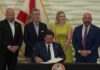
A top Trump defense move just put NATO on notice: Europe must finally defend itself or risk losing America’s military shield.
Story Snapshot
- Defense Secretary Pete Hegseth launched a six-month review of all U.S. forces based in Europe, branded “NATO 3.0.”[1][3]
- The review’s goal is to shift NATO toward Europe taking primary responsibility for its own conventional defense, not relying on U.S. taxpayers.[1][7]
- Some U.S. air and naval assets for NATO crises are already being cut, signaling that Washington is serious about burden shifting.[3]
- Conservatives argue this realigns U.S. power toward the Pacific and the homeland after decades of European “free riding.”[3][9]
Hegseth’s NATO 3.0 Review: What It Really Means
Defense Secretary Pete Hegseth stood before NATO defense ministers in Brussels and said out loud what many American conservatives have thought for years: the United States will no longer be “primarily focused on the security of Europe,” and it is time for Europe to lead its own defense.[1][9] He announced a sweeping six-month review of U.S. troop posture and bases across Europe, a “real review” that will shape where American forces stay, where they move, and where they may leave.[1][3] Hegseth framed this as “NATO 3.0,” a new phase where Europe steps up and takes primary responsibility for its own conventional defense, while the United States focuses more on deterring war with China and protecting the homeland.[1][7][9]
The review will pull in U.S. European Command, Congress, and allied governments, with recommendations due in six months.[1][3] Hegseth did not promise specific troop cuts on day one, but recent U.S. moves already point that way. Washington has quietly told allies it is reducing the forces it pre-commits to NATO in a crisis, including support aircraft, drones, and warships.[3] One military source says the number of F‑15 and F‑15E fighters earmarked for NATO will drop by about one-third, and MQ‑9 Reaper drones by half.[3] For Europeans, that is a sharp signal that the free ride is ending. For American taxpayers, it is a sign the Trump team hears long-standing anger over paying Europe’s security bill while facing debt, inflation, and open borders at home.
Why Conservatives See This Review as Long Overdue
For decades, both parties in Washington allowed a Cold War–sized footprint in Europe even after the Soviet Union collapsed, leaving more than 80,000 U.S. personnel on the continent while wealthy European nations underinvested in their own forces.[7] Analysts who favor a more restrained foreign policy argue that this oversized posture encourages “free riding,” keeps Europe dependent on U.S. power, and drains resources needed to deter China and secure the southern border.[3][7] Defense policy studies have laid out detailed plans to cut U.S. troops in Europe by 30,000, slash air and naval forces by about half, and return the overall footprint to pre‑2014 levels while keeping only a limited “tripwire” presence and the U.S. nuclear umbrella.[3][7] Hegseth’s NATO 3.0 language tracks closely with that logic: America will still back Europe, but not carry the whole load.
Hegseth has linked this review to “stark strategic realities” in the Pacific, telling allies that the United States must prioritize deterring a Chinese attack and cannot keep treating Europe as the main theater.[9] At the same time, U.S. planners are looking at how to reduce permanent forces in Europe over the next decade, while keeping enough infrastructure to surge back in a true crisis.[19] This approach matches a core conservative instinct: focus on vital interests, cut mission creep, and demand that rich partners pay and act like adults. For many on the right who are tired of endless commitments, sprawling deployments, and Pentagon budgets that still cannot stop the flood at the southern border, the idea of Europe finally “owning” its defense feels like basic fairness.
European Anxiety, Alliance Politics, and What Comes Next
European officials are nervous, and they are saying so. Some fear that competition for a smaller U.S. presence could fracture NATO’s eastern flank, as countries fight over where the remaining American units should sit.[20] Others, especially on the front line near Russia, still push for more U.S. boots on the ground and even argue for more permanent armored forces instead of short rotations, which they see as less reassuring.[21] At the same time, serious U.S. Army studies stress that forward presence has real value for deterrence and alliance cohesion, and warn that the wrong kind of cuts could raise doubts in Europe and invite miscalculation.[5][21] The Trump administration’s own record shows how sensitive this is: past announcements about pulling troops from Germany, pausing moves to Poland, and then sending 5,000 more troops to Poland left allies feeling “whiplash” even as they heard the core message on burden sharing.[1][20]
BRUSSELS—@SecWar Hegseth announced that the Pentagon will conduct a six-month review of America’s posture and basing in Europe during a meeting of NATO’s North Atlantic Council.
In addition to a push for increased European defense spending, Hegseth said some nations lack of…
— Chris Gordon (@ByChrisGordon) June 18, 2026
Hegseth’s new review comes on top of a separate decision not to release a full Global Posture Review document this year, breaking with past practice and worrying some lawmakers and allies who want more visibility into U.S. plans.[6] Instead, the administration is using speeches, quieter briefings, and moves like NATO 3.0 to signal direction: less automatic commitment in Europe, more focus on the Western Hemisphere and the Pacific, and tougher conditions on U.S. financial contributions if allies keep dragging their feet on defense spending.[3][6][13][16] For conservative readers, the stakes are clear. If Hegseth follows through, America may finally stop acting like “Uncle Sucker” in Europe and start forcing wealthy allies to choose: build up real hard power, or watch the U.S. footprint shrink.
Sources:
[1] Web – Hegseth tells NATO US will review force presence in Europe
[3] Web – [PDF] Fact Sheet: Posture Updates in Support of Allies in Europe
[5] Web – No surprises? Preparing for the US defence strategy and posture …
[6] Web – As We Await the Pentagon’s Posture Review, Here’s One Country …
[7] Web – Allies and Congress are about to lose a key window into US military …
[9] Web – Striking the Balance: US Army Force Posture in Europe, 2028—A …
[13] Web – Hegseth Tells NATO US Will Review Force Presence In Europe
[16] Web – US military’s future in Europe under review as Hegseth …
[19] YouTube – “US military presence in Europe may not be forever”, warns Hegseth
[20] Web – Revisiting the Global Posture Review – Marine Corps University
[21] YouTube – U.S. Military Posture and Implications for European Security
© dailyvantage.com 2026. All rights reserved.