Florida’s new terror designation law has opened a fierce clash between state power, civil rights, and free speech, leaving many Americans wondering how far governments can go to police “terrorism” at home.
Story Snapshot
- Florida Governor Ron DeSantis used a new state law to label CAIR, the Muslim Brotherhood, Antifa, and dozens of foreign groups as terrorist organizations.
- State officials say the law mainly blocks taxpayer money and state benefits from going to these groups and their supporters.
- CAIR and allied civil rights groups argue the move is baseless, unconstitutional, and aimed at silencing Muslim advocacy.
- Federal courts have already pushed back, warning that Florida’s approach likely violates First Amendment free speech protections.
DeSantis Uses New Law To Expand Terror Designations
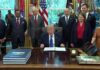
Governor Ron DeSantis has moved aggressively to use Florida’s 2024 House Bill 1471, a law that lets certain state officials formally designate domestic terrorist organizations and cut off state funding to them. He followed this by executive order in December 2025, naming the Council on American-Islamic Relations (CAIR) and the Muslim Brotherhood as terrorist organizations and directing state agencies to block contracts, jobs, and funds from anyone who materially supports them. Supporters see this as Florida stepping in where they believe Washington has failed.
Florida’s law also bars state and local governments, colleges, universities, and K–12 School Choice scholarship programs from funding organizations linked to groups on the state’s terror list. That means schools or nonprofits seen as “affiliated” with CAIR or the Muslim Brotherhood could lose access to taxpayer money, even if they have never been charged with a crime. For many readers who already worry that elites misuse public funds, this feels like long‑overdue oversight; for others, it looks like politicians picking winners and losers.
CAIR’s Terror Label Tied To Old Federal Case, But No Charges
DeSantis and his allies point to the Holy Land Foundation terror financing case as a key reason to target CAIR. In that 2008 federal trial, the Holy Land Foundation and several leaders were convicted of sending over $12 million in material support to Hamas, which the federal government lists as a foreign terrorist organization. CAIR appeared on a government list of “unindicted co‑conspirators” in that case, meaning the government suspected involvement but never brought charges. That status has fueled years of conservative claims that CAIR sits in a network close to Hamas.
However, CAIR has never been indicted or convicted of terror‑related crimes, and the trial record stated there was “no allegation that [Holy Land Foundation] gave money directly to Hamas.” Later, a federal district court and the Fifth Circuit Court of Appeals ruled that publicly naming unindicted co‑conspirators in that case violated due process rights, undercutting the government’s move to put CAIR on that list. Civil rights lawyers now argue that using this disputed label as a main pillar for Florida’s terror designation is legally weak and unfair.
Civil Rights Groups Push Back In Federal Court
CAIR and CAIR Florida quickly sued DeSantis and state officials, claiming the designation is “baseless” and unsupported by any public evidence. Their corrected complaint stresses that no agency has charged CAIR with terrorism, and that branding it a terrorist group threatens its existence in Florida by scaring off donors, partners, and landlords. The American Civil Liberties Union (ACLU), the Southern Poverty Law Center, and other groups also filed suit, arguing that Florida’s law violates the First Amendment and Fourth Amendment by punishing advocacy and enabling broad investigations with thin cause.
A federal judge in the Northern District of Florida has already issued a preliminary injunction against parts of DeSantis’s December 2025 executive order, finding that Florida likely violated the First Amendment by pressuring third parties to suppress CAIR’s speech. That ruling signals serious constitutional trouble for the state’s approach. It also speaks to a wider fear on both the left and the right: when government can label advocacy groups “terrorist” without clear standards, almost any unpopular voice could be next.
Antifa, Cartels, And The New State-Level Terror Trend
DeSantis did not stop with CAIR and the Muslim Brotherhood. He also designated Antifa as a domestic terrorist organization, citing violent actions, including a 2020 incident at the governor’s residence. Florida officials say HB 1471 helps them target violent crime, fentanyl trafficking, and human trafficking linked to cartels and other groups, by tying these networks to state terror lists and cutting off benefits for supporters. Yet public records so far show little detailed evidence of Antifa’s formal structure or specific terror plots in Florida.
Gov. Ron DeSantis announced Florida is officially designating Antifa, CAIR, the Muslim Brotherhood, and over 90 foreign drug cartels as terrorist organizations under a new state law. 👇 pic.twitter.com/bncKhQQx0G
— TMcCarty (@Jatrac04) July 8, 2026
Florida’s move fits a broader national trend. Since 2024, several “red state” governments and Republican leaders have pushed state-level terror designation schemes that reach domestic nonprofits and civil rights groups, not just foreign militias. Texas previously used state law to restrict CAIR’s real estate dealings, and Indiana has adopted similar tools. Critics say these laws weaponize the language of “terrorism” to sideline political opponents and advocacy organizations. Supporters argue they are necessary because federal agencies, in their view, drag their feet on groups tied to radical Islam or far‑left violence.
Shared Concerns About Power, Free Speech, And The “Deep State”
For many conservatives, Florida’s law speaks to real anger at what they see as weak federal action against groups linked to Hamas, cartels, or street violence. They feel Washington protects “woke” nonprofits while ordinary Americans pay the price in crime, drugs, and cultural breakdown. For many liberals, this same law looks like proof that politicians now use “terror” labels to crush dissent, especially from Muslims, protesters, and critics of U.S. foreign policy.
Underneath the partisan fight, a deeper shared worry stands out. These designations show how easily powerful officials can make life‑changing decisions about who is allowed to speak, organize, and receive public support, often based on evidence the public never sees. Federal courts are starting to push back, but the battle is far from over. Whether one cheers or fears DeSantis’s actions, this Florida case raises a basic question that crosses party lines: who watches the watchers when “terrorism” becomes a political tool?
Sources:
thegatewaypundit.com, justice.gov, adl.org, investigativeproject.org, capitol.texas.gov, flsenate.gov, news.bloomberglaw.com, wusf.org, wlrn.org, aclu.org, facebook.com
© dailyvantage.com 2026. All rights reserved.